Wheat and Malt
Whether you are a complete beginner or you have been knitting for years, the first 2 designs from The Simple Collection have something for everyone.
An easy combination of stockinette, garter, and ribbing make the Wheat scarf and the Malt blanket cozy knits that fly off the needles. The patterns are perfect for beginners, and a treat for knitters who love modern lines and simple details.
Emily and I originally met while working at a yarn shop in Vancouver (Urban Yarns). We spent our days helping people pick out the perfect combination of pattern, yarn, and needles. One of my favourite tasks was setting up a new knitter with their very first project. Most of the time I would set them up with a project that would mean lots of practice: the scarf. A scarf is a wonderful first project because there is no issue of fit (just keep going if it’s too short!) and a simple scarf offers a lot of knits and purls, a perfect place to figure out your personal knitting style and tension. And so we offer Wheat, a reversible scarf to learn and practice your knits and purls on.

WHEAT PROJECT DETAILS :::
yarn:Sweet Fiber Cashmerino Worsted in ‘spanish coin’ (400 yards)
suggested needles: US 8/ 5mm (either straights or circulars will work)
size: the finished scarf will be approximately 8″ wide by 60″ long
pattern: Free! download the Wheat Scarf pattern now


Another reason people find themselves inspired to knit are new babies! New and expectant mums come into the shop with visions of tiny babies swaddled in a blanket of their own creation. Grandmas-to-be would return to knitting after a hiatus, ready to pick up the needles and create an heirloom for their little Grandbaby. We designed Malt with these loving customers in mind.

MALT PROJECT DETAILS :::
yarn:Sweet Fiber Cashmerino Worsted in Tea Leaves (750 yards)
suggested needles: US 8/ 5mm
size: the finished blanket will be approximately 30″ wide by 32″ long
pattern: Free! download the Malt Blanket pattern now


Hunter is cuddled up in the Malt blanket, and is wearing the Barley Hat – one of the upcoming Simple Collection free patterns! The Barley hat pattern (including tutorials on knitting in the round) will be available in July 2013.
The Simple Collection Tutorials ::: If you have never knit before, or used to knit but have forgotten how, we have step-by-step tutorials on each technique you will need for both Wheat and Malt. From casting on and knitting, to binding off and blocking, we will be with you each step of the way. Start by casting on now!
The Yarn ::: Wheat and Malt are knit in Sweet Fiber Cashmerino Worsted, which is currently one of my very favorite yarns. Buttery soft with beautiful subtle shifts in colour, this yarn is a sweet treat indeed! Composed of superwash merino, cashmere, and nylon, this yarn is both soft and practical, as it is machine washable (but I always lay my knits flat to dry). After knitting Malt it became Jonesie’s car-seat and stroller blanket, and even though it has received some hard use it still looks as new as the day it came off the needles!
Like the new Simple Collection? To hear about our new designs and in-depth tutorials as they are released, get our email updates! Please help us to spread the word about these new designs by clicking the links below to share on facebook, twitter, or email to a friend. Do you teach knitting? To make your life easier, we have created downloadable PDF handouts that you can use (along with the free patterns) in your knitting classes – download them here.
Looking for other simple designs from Tin Can Knits? Check out some of the others:
Let’s knit a scarf
Sometimes it can seem daunting to learn something new, so let’s take it one step at a time, and knit a simple scarf together. Be sure to click the links for detailed tutorials illustrating each technique.
First, download the Wheat scarf pattern, gather your materials, and let’s get started!
The Materials ::: knit with yarn that you love

For our scarf, we used Sweet Fiber Cashmerino Worsted in the colourway ‘spanish coin’ and 5mm circular needles (if you don’t know a thing about yarn or needles check out this post <coming soon>). There are many yarns and needles that will work for your first scarf so we recommend a trip to your local yarn store if you have one. Bring the pattern and they will set you up with everything you need.
Your Local Yarn Store ::: the best place to begin
If you are lucky enough to have a yarn shop near you it can be a wonderful resource. The LYS (local yarn store) often has friendly and helpful staff, classes you can take, or knit nights when you can drop in. While it is a faux pas to assume the staff can give you a knitting lesson on the spot, they can often help with smaller issues, point you in the right direction, and they can certainly help you choose your project materials.
The Pattern ::: we are keepin’ it real simple to start
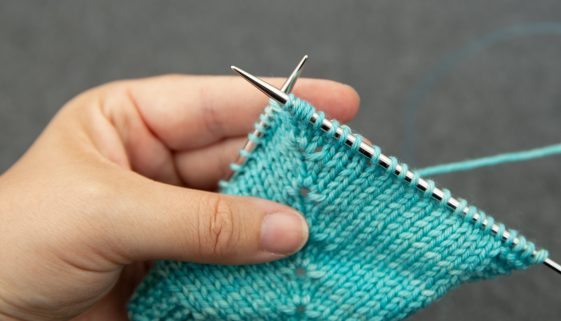
Back to our scarf. Following the pattern instructions, cast on 35 stitches and knit each row until your piece measures 3 inches from the cast on. Once you have reached this point, your knitting will look like this:

Next we will place markers to indicate where the ribbing goes in this scarf. Both ribbing and garter stitch look the same on both sides so having both in a scarf makes for a simple design and a reversible finished project. You will place your markers by slipping them over the needles. Markers go on your needles BETWEEN the stitches. You never knit into them, simply slide them from your left-hand (LH) needle to your right-hand (RH) needle as you come to them. For more information on purling (which you will need to accomplish your ribbing), see this tutorial.
Once you have placed your 2 markers, your work will look like this:

Once you have worked a few rows with both garter and ribbing, the pattern will start to form like this:

Although you are only a 4 inches into your scarf you have already learned almost everything you need to know! You will keep going, working the ribbing between the markers and garter stitch everywhere else. Unless you have an unusually large ball of yarn, you will need to start a new ball of yarn <link> at some point in your scarf, at least once.
Once your scarf reaches 57 inches (or 3 inches short of your desired length), you remove your markers and knit every row for 3 inches.

Bind off all stitches and cut your yarn, leaving a 4 or 5 inch tail. Voila a scarf! You will notice 2 things about your new garment, the first is that there are some literal loose ends, and the second is that it seems to ‘pinch in’ where there is ribbing. There are 2 simple finishing steps to take: blocking and weaving in your ends.
While this tutorial looked specifically at the Wheat Scarf, all of the techniques apply to the Malt Blanket, our other beginner knitting pattern. Check it out!
Enjoying the Simple Collection? Get our email updates and we will let you know as new free patterns and tutorials are released! And if you like the designs, be sure to share them with friends and knitting groups.
Simple Collection Designs by Tin Can Knits:
Blocking Basics
Once you have finished your scarf it’s time to block. I always block my knitting before weaving in the ends.
The fabric can change with blocking and you wouldn’t want your ends to start trying to get out!
Why block? I have a confession: I never used to block my knitting. It seemed fussy and unnecessary. What real difference could a little water and laying your knitting flat accomplish? Boy was I wrong. I’m a big convert to the world of blocking (thank you Emily) so I hope you will be too. Blocking consists of wetting your knitting and laying it flat, the way you want it, to dry. When you block things like lace it can get a little more complicated but that’s the gist of it. Your stitches will look smoother and more even and if you have changes in fabric (like garter to ribbing for example), it will help to even these changes out. So let’s get blocking!
Materials :::
1. Pins: I use T-pins (they are literally shaped like T’s) but any stainless steel pin will do. You want to make sure that your pins won’t rust because rust and knitting are not a good combination.
2. Something to block on: I bought these foam puzzle pieces at the hardware store but a piece of cardboard will do fine. You just need something to stick your pins into that will allow your knitting to dry.
3. Wool wash: something like Soak or Eucalan are popular wool washes. Read the label to see if you need to rinse your knitting or not. Soak is a leave in wash and a squirt the size of a dime will do for a scarf.
4. Something to soak your knitting in: either a clean sink or a clean basin. Emphasis on clean!
5. A towel: this is to squeeze out any excess water from your knitting.
Instructions :::
1.Fill your sink or basin with cool water and your woolwash
2. Wet your knitting. I do this by submerging my knitting and pressing out the bubbles. You don’t want to agitate your knitting too much. Leave it for about 15 minutes to get it good and soaked.
3. Take your knitting out of the water and press out as much excess as you can. Do not wring your knitting, this can put it out of shape permanently.
4. Roll your knitting in a towel and stomp on it, this is also to remove excess water
5. Lay your knitting out on your blocking boards and using your hands push it into shape. You want to lay your knitting out just the way you want it to look. For a scarf you need to create an even width and straight edges. Pin into place.
Your knitting should dry in a day or 2 depending on the climate (I love blocking outside in the summer, it’s so quick!). If your knitting takes more than 3 days to dry, start over. Your knitting will have a not-so-fresh smell to it. Try again, this time squeezing more water out before pinning.
This is basic blocking, but there other, more exacting, ways to block your knitting. How you block your garment will really depend on what it is and what sort of fabric you have. You might not use pins for a sweater (unless it has lace or cables) or if you are blocking a lace shawl you might want to use blocking wires. While blocking may seem fussy at first it really makes a big difference in the finished product. You spend so much time hand knitting, what’s a day or 2 for a block?
Weaving in Yarn Ends
Any time you cast on, bind off, change colors, or start a new ball of yarn you will have a little ‘tail’ of yarn. Once you are finished with your knitting you will want to get rid of these tails by weaving the ends into your knitting.
While tying a knot and snipping your yarn close is tempting, DON’T DO IT! Even if you tie a knot (which is a faux pas in knitting, but that’s a story for another day), simply snipping the yarn close will not keep your knitting from unraveling. You must weave your ends through your knitting, helping the ends to ‘mesh’ with the rest of your knitting. After a little bit of wear your ends will become part and parcel of your finished item, no chance of them slipping loose!
Weaving in ends and sewing on buttons are always the last things I do for my knitting. I weave in my ends after I have blocked my knitting and done any sewing that needs to be done. So let’s get finished!
For this task you will need a darning needle. There are many types, but I like the kind pictured below, with a sharp point and a little bend to it. To begin weaving in your ends make sure the wrong side, or inside, of your work is facing you (if your item is reversible just pick a side and stick with it)
1. Thread your darning needle with your loose end.
2. Weave the yarn up and down through a ‘line’ of stitches, pulling your yarn through (but not too tightly) as you go. Do this for 3 or 4 stitches
3. For the last couple of stitches, split the yarn. This allows for a maximum ‘meshing’ of your end and your knitting. Do this for another 2 or 3 stitches.
4. Cut your end. Your weaved in stitches should look something like this
Repeat these 4 steps for all the ends in your work.
Learning to knit or teaching a friend? Check out The Simple Collection – a step-by-step learn to knit program with 8 excellent free patterns, and clear tutorials to guide you. If you are a knitting teacher, we have created PDF tutorial layouts that you may find useful to hand out in your class.
Free Patterns from The Simple Collection:
Joining a ball
Unless you are knitting a 1 skein wonder, you will need more than 1 ball of yarn to complete your project. Whether you are working in a new color, or just adding a new ball, the method for joining is the same.
Join a new ball at the beginning of a row or somewhere inconspicuous (like under the arm if you are knitting a sweater) where possible. Always try to leave a 4 or 5 inch tail of the old ball.
- Insert your needle ready to work the next stitch (or the first stitch of the row as the case may be).
- Instead of wrapping your right needle with the old yarn, place a loop of the new yarn around the needle. Make sure to leave a 4 or 5 inch tail of yarn (if it’s too short it may come out or it will be difficult to weave in)
- While holding both the tail and the working yarn of the new ball, pull the stitch through.
- Work a few more stitches with the new yarn (they may feel a little looser than usual)
- Pull the tail from the old yarn and the tail from the new yarn to tighten up the loose first stitches.
I sometimes tie the two tails together in a loose knot so they won’t unravel or get in my way. When I am finished with the item I can undo this knot to weave in the ends.<link>
Are there other parts of learning to knit that you are unsure about? It is our goal to inspire and educate – so stay in touch! We love to hear your questions and comments – ask and we will do our best to point you in the right direction.
New Summery projects by Tin Can Knits:
Garter Stitch, Stockinette Stitch, and Ribbing
Once you know how to knit and purl, you can combine these stitches in many different ways to make knitted fabrics with different sorts of characteristics.
The combination or pattern of knits and purls is called a ‘stitch pattern’. The Simple Collection designs use three basic stitch patterns: Garter Stitch, Stockinette Stitch, and Ribbing. Grab some needles and yarn, and try them out yourself!
GARTER STITCH ::: (is very easy)
You make garter stitch by knitting every row, right sides (RS) and wrong sides (WS).
Garter stitch is bumpy, stretchy, and lays nice and flat. It is reversible, it looks the same on both sides.
Garter Stitch is soft and cushy (like the marshmallow mitts)

The Marshmallow mitts are all-over garter stitch, for maximum fluffiness!
Makes a nice edging (like on the Malt blanket)

Garter edge on the Malt Blanket (a free pattern)
And because it is so simple and effective, we have used it really extensively in our Simple Collection designs (perfect for learners)!
STOCKINETTE STITCH ::: (is very easy too)
Stockinette stitch is made by knitting one row (RS – right side) then purling the next row (WS – wrong side), then repeating these two rows, so you always knit on the RS of the work, and purl on the WS of the work.
Stockinette stitch is quite smooth on the RS or knit side, and has a uniformly bumpy texture on the backside (this is called Reverse Stockinette Stitch).
Smooth and sleek (like the body of the Antler Cardigan)

The body of the Antler Cardigan is stockinette stitch.
Reverse stockinette looks somewhat more rustic and textural: (like the Hipster Hat)

The Hipster hat is mostly reverse stockinette, for a rustic effect.
Stockinette stitch, worked on its own, has a strong tendency to curl. At the side edges it curls toward the back, and at the cast-on and bind-off edges, it has a tendency to curl toward the front. This means a stockinette stitch scarf isn’t going to stay flat for long… But it is interesting to use this ‘curl’ as a design feature – like I did at the sleeves of the Low Tide cardigan, and at the neckline of the Raindrops pullover. A little rolled edge can be a cute and informal detail.

The neckline and cuffs of the Raindrops pullover have a stockinette stitch rolled edge.
RIBBING ::: (isn’t too hard with a little bit of practice)
Ribbing is a general term for a set of stitches that alternate vertical columns of knits and purls. In the Simple Collection, we use a lot of 1×1 ribbing, which alternates 1 knit and 1 purl at a time.
For Beginners ::: the most important thing to note is when you switch from a knit to a purl in a single row, you MUST move your yarn from the back of the work (where it is when knitting) to the front of the work (for purling), bringing it in between the needles (not over the needles, or you will create an extra stitch). A video illustrating this very important point is coming soon…!
You make 1×1 ribbing by working the following pattern (on an even number of stitches):
Row 1 (RS): (k1, p1) repeat to end.
Row 2 (WS): (k1, p1) repeat to end.
Repeat rows 1-2, and a pattern of columns will form. Another way of knowing how to knit the stitches in ribbing is to look at them. If the stitch looks like a knit (a little V shape) then knit it. If the stitch looks like a purl (a little bump), then purl it. It is as simple as that.
Ribbing is great for edges because it pulls in, so it is nice for necklines and cuffs.

2×2 rib at the hem of the Lush Cardigan
If ribbing has an even number of knits and purls (1×1, 2×2, or 3×3) then it is reversible and looks the same on the right side and the wrong side. This is great for scarves!

reversible 1×1 ribbing panel on the Wheat Scarf (a free pattern)
There are an unlimited number of ribbing patterns. Perhaps you want a chunkier looking edge – try 2×2 rib (k2, p2) repeat to end. Or if you want a sleeker looking rib try 3×1 rib (k3, p1). Each pattern has a slightly different effect. See how we used 1×1 rib on the brim of the Sitka Spruce hat, and 2×2 rib on the brim of the Tofino Surfer hat, and really big 6×3 ribbing on the edge of the Drift? There are many different effects you can achieve.

1×1 twisted ribbing at the brim of the Sitka Spruce hat (to make twisted ribbing you knit into the back loops of the stitches).
twisted ribbing is when you knit into the back loop of the

2×2 ribbing at the brim of the Stovetop hat

really fat ribbing at the edge of the Drift Shawl
How to Bind Off
You are on the home stretch!
After you have completed a piece of knitting, you finish the edge by binding off the stitches.
This way you can remove the knitting needles without the work unravelling. There are several bind off methods, but we will start with a basic knit bind off.
HOW TO BIND OFF :::
1) Knit 1 stitch
2) Knit a second stitch. There are now 2 stitches on the RH needle.
3) Use the LH needle point to lift the first of these two stitches up and over the second of these two stitches, letting it drop off the needle. This is 1 stitch bound off.
Repeat steps 2-3, knitting a stitch (so there are two stitches the RH needle) then lifting the first up and over the second and off the needles. Continue until a single stitch remains on the RH needle. To prevent this final stitch from unravelling, snip the working yarn, and draw the tail through the final stitch, then pull tight.
But now that I’ve bound off, what do I do with the yarn ends? Check out this tutorial.
Do you find these tutorials helpful? Get our email updates and we will let you know as new free patterns and tutorials released! Please help us give back to the crafting community – share this with your knitting group, or tell the folks at your LYS (local yarn store) about the free patterns and clear tutorials in the Simple Collection.
Simple Collection Designs by Tin Can Knits:
Whether you are a complete beginner or you have been knitting for years, the first 2 designs from 


You are on the home stretch!