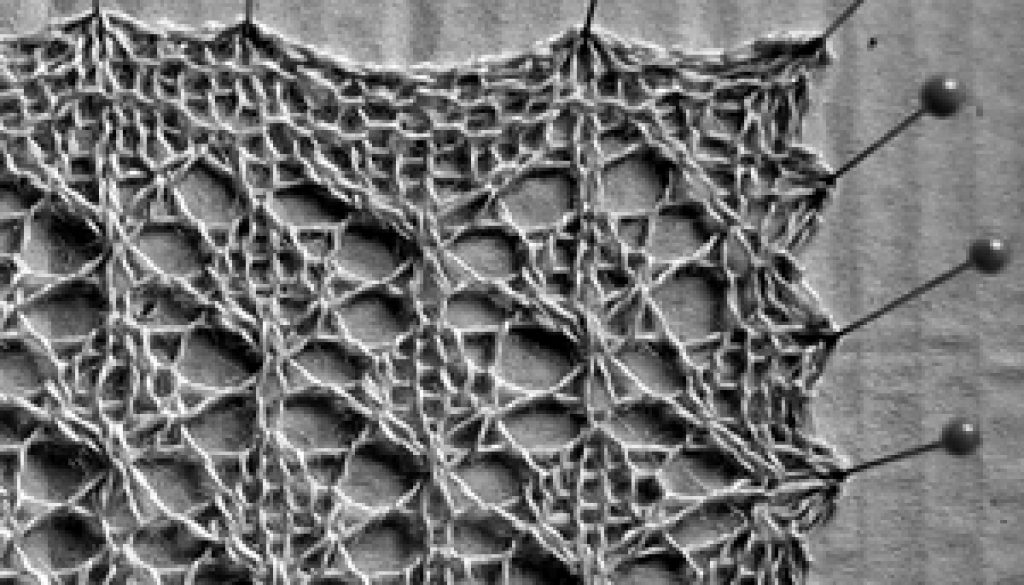
After making some initial decisions about colour, shape and concept (discussed in the previous post), you need to start choosing stitch patterns for your shawl. Flip through stitch dictionaries until you find some charts which appeal to you. This post will explain how to create charts and come to a deep understanding of the lace pattern you want to use in your design!
HOW TO CHART OUT A SIMPLE LACE PATTERN
Once you have picked a few patterns to try out, you will need to make swatches to test them out, and convert them into charts, so that you can work with them in your design. Today we’re going to look at how to chart a simple lace stitch pattern. This pattern is simple because: all wrong-side (WS) rows are simply purled, and the stitch count remains the same on every row. This makes it quite easy and clear to chart. In a future post I will give my process and tips for working with more complex lace patterns. All the abbreviations used in this post are listed here.
Little Leaf Lace – multiple of 6 stitches plus 1
Row 1 (Wrong side) and all other wrong-side rows: Purl
Row 2 (RS): k1, (k2tog, yo, k1, yo, ssk, k1) repeat to end
Row 4: k2tog, (yo, k3, yo, sl2-k1-p2sso) repeat, ending last repeat ssk instead of sl2-k1-p2sso
Row 6: k1, (yo, ssk, k1, k2tog, yo, k1) repeat to end
Row 8: k1, (k1, yo, sl2-k1-p2sso, yo, k2) repeat to end
Charts are a visual representation of knitting instructions. Each stitch is represented by a symbol in a square. As a general rule, charts represent how the stitches will be knit/look when viewed from the right side (RS) or front of the work. You read, and write, all right-side (RS) rows from the right hand side of the chart to the left-hand side (in the same direction that you will be knitting the work). You read, and write, all wrong-side (WS) rows from the left-hand side to the right-hand side.
To begin, you will need graph paper and a pencil. First choose the symbols to use in your chart, and draw your chart key. I used these ones, which are very common.

First you will draw a horizontal line to define the bottom of your chart, and a vertical line to define the RH edge of the chart. The Little Leaf Lace pattern is written so that the first row is a WS row:
Row 1 (Wrong side) and all other wrong-side rows: Purl
A purl stitch worked on the WS is a knit stitch on the RS, so we simply leave the first line of the chart empty, and proceed to the second row.
Row 2 (RS): k1, (k2tog, yo, k1, yo, ssk, k1) repeat to end
Starting at the right-hand edge of the chart, number row 2, and insert the appropriate symbols into the graph squares one by one, working from right to left as the pink arrow indicates. I put little vertical lines in the chart where the brackets indicate a chart repeat. I also find it is best to chart out at least 2 repeats of a pattern to begin.

After you have done that, proceed to chart out the rest of the pattern in exactly the same way

Once you have completed the charting, you can see that the little vertical lines that indicate the repeats line up. Draw heavy lines through them, to indicate the pattern repeat.

Notice how all the WS rows are empty? When you have a pattern like this, you can eliminate these rows from the chart, and simply include a note to purl all WS rows. I also prefer for the RS rows to have ODD numbers, so I’m going to renumber my chart, making the first RS row Row 1, instead of Row 2.

Now the chart is much more compact and the decreases line up. The structure of the chart now resembles the form of the knitted lace itself. I also like to chart out an extra repeat or two to see the overall effect of the pattern.

Once you do this, you can begin to see the structure of the lace, and analyze how it is formed. This will also become more and more clear as you knit your swatch, and ‘get to know’ the lace properly.

What you will notice as you knit the swatch is that the lace is really formed of two rows, which are offset half a repeat (3 stitches) horizontally from one another. This is what causes the offset motif. Lovely!

Once you have charted a pattern, and knit a sample, you will have intimate knowledge of how the lace is formed. This is crucial for the next steps in the shawl design process; because you will need to shape the lace in order to make it into a shawl, and transition from one lace stitch pattern to another in a seamless / elegant way.

SO WHAT DO YOU WANT TO CREATE? As Diane and I work together on our collaborative shawl design, I will continue to write about the shawl design process, swatching, charting, and shaping lace, choosing borders, and adjusting stitch patterns.
This is a very in-depth design process so I can only work directly with one person, but I would love to have you join in, ask questions, and work alongside us to develop your own designs. A great place for this conversation to happen is on the Tin Can Knits Ravelry group – check it out and join us for design debates. And as always, we love to hear from you, so leave a comment, or pop us an email!
Like this? Share on Facebook and get our email updates! Thanks for your support, ♥ Emily & Alexa
Some Lace Shawl Patterns you might like:






January 17, 2020 @ 11:53 am
HI,
I purchased a book, 60 More Quick Knits, produced by Cascade Yarns. In it is a leaf pattern called Lace-Panel Scarf. I wanted to knit it and after following the 16 row pattern row sequence 3 times and ripping it out, I came to the conclusion that the number of stitches you ended up with at the certain rows were incorrect. Three times it is noted how many stitches you should have at the end of the row and on the third row, you can count the number of stitches you have added and subtracted and it does not add up. I wanted to create a graph to follow because efforts to contact Cascade and the author of the pattern failed. The leaves are not adjacent to each other they are off set like a real leaf sequence.Any ideas how I can create a pattern I can follow as opposed to this one that doesn’t work?
January 23, 2020 @ 11:55 am
Hi Theresa – I would try using graph paper and writing it out as written, it should help you to see the errors. You also might want to check the errata page on the Cascade website, it might have the fix on it.
It’s a SNAP | Tin Can Knits
March 8, 2018 @ 6:09 am
[…] year I’m teaching ‘Off The Charts’, which is an ode to my love of charts as a design tool, and ‘Strange Brew‘ in which participants design their own colourwork […]
March 7, 2014 @ 10:06 pm
This is really helpful, especially seeing structure and pattern and then having this superimposed on the swatch. Thanks.
At the end of part one, you wrote that other parts would show “how to create shaped lace charts, how to transition from one lace pattern to another, and how to design edging patterns that work with your chart repeat!” I’d love to read this but haven’t been able to find them. Are they somewhere online or maybe other things got in the way and you didn’t have the chance to write them :-(
March 14, 2014 @ 4:05 am
They are in the works! Coming soon….
May 23, 2016 @ 7:31 am
I have been scouring the net for exactly the next section (how to create the shaped lace charts etc) – I struggle with the mathematical side of knitting and have been trying to find somewhere that explains how to work lace charts into your chosen shawl-shape increase structure. Did the next part get written, in the end, as it sounds like exactly what I’m looking for!
May 2, 2017 @ 5:22 am
I see your comment is from a couple of years ago. We’re you able to get these posts up? Would love to read them!
Thanks for these articles! I have a lot to learn. Heading over to your Ravelry forum now. . .
March 5, 2013 @ 8:14 am
I’m knitting a top-down lace cardigan and I’m choosing the lace motifs from my charted knitting books (like Barbara G.Walker’s) as I go. These charts are all written to be knitted from the bottom up. Sometimes the motifs look just fine up-sid-down but sometimes not, so when it mattered I originally tried to simply knit the patterns by working the charts from the top down but I lost all of my ridges, presumably because my decreases were now slanting in the wrong direction. So, I knitting them from the top down swapping left for right and right for left leaning decreases. Still no ridges. Then I flipped the chart up-side-down…no luck. Have you run into this dilemma? I’ve spent hours searching for an answer and I’m going kind of coo coo. I can’t figure out what’s not working. Any help would be much appreciated. Thanks.
March 11, 2013 @ 12:53 am
I haven’t actually tried reversing motifs to be worked in the opposite direction. I think it I did, I would look at it as a complete re-design of the motif, because something quite different is occurring. When you have a decrease to a point, say a triangular decrease, you would work
Row 1: … yo, ssk, k3, k2tog, k3, yo, …
Row 3: … yo, ssk, k1, k2tog, k1, yo, …
Row 5: … yo, sl1-k2tog-psso, yo, …
and these rows would have formed a solid triangle, with ridges leading to a point at the top of the triangle.
But if you want to turn this around and have the triangle open up from bottom up, then you would work something like this:
Row 1: … k2tog, yo, k1, yo, ssk, ….
Row 3: … k2tog, yo, k3, yo, ssk, …
Row 5: … k2tog, yo, k5, yo, ssk, …
That way you’d have a triangle of increasing width, framed by ridges on the outside of the yarn-overs. The yarn overs create the new fabric / sts. which are in the triangle.
Does this make sense? As far as I can see, there’s no real way to get exactly the same effect when working in the opposite direction. You might try Cookie A’s sock book for further info though – she has some really great technical explanations of working with charts.
Good luck! Emily Wessel
June 22, 2012 @ 9:33 am
This is amazing! Thank you so much for this! I love lace and have seen so many gorgeous stitch patterns but always was too scared to try them out. Thank you for giving me the guts to try! :)