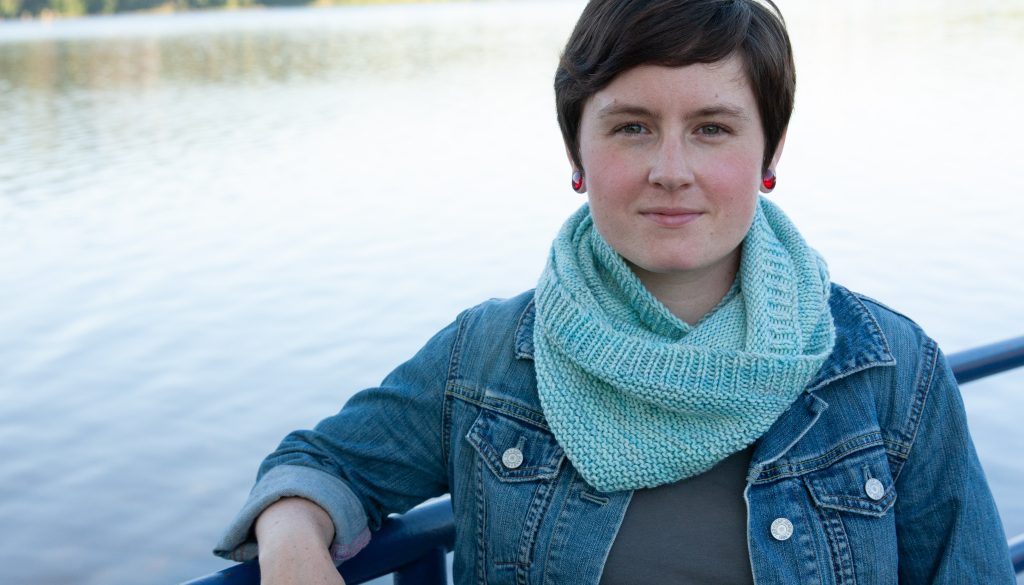
The Oats cowl is a great project to learn many basic knitting skills. You’ll learn how to knit in the round, use markers, and work ribbing, garter, and stockinette, all in a VERY simple project! Download the free Oats cowl and let’s get started.

This pattern is EVEN BETTER in the Tin Can Knits app!
- see only the instructions you need
- tick through the pattern and make notes
- support is just a tap away
- adjust the settings to suit you!
Steps to knit an Oats cowl
- Materials
- Yarn
- Needles
- Choose your size
- Gauge and swatching
- Cast on
- Ribbing in the round
- Placing markers
- Garter and stockinette
- Finishing

Materials
The materials section of a pattern (the very first thing you look for) can be a bit daunting! If you’re new to pattern reading you can check out our tutorial on reading a knitting pattern here.

Yarn
The Oats cowl includes directions for 3 different yarn weights; sock/sport, DK, and worsted/aran. This means you can use the yarn you’ve got on hand! If you’re wondering what we mean by yarn weight, and what the heck DK is, check out our tutorial on yarns here.
Different yarn weights have different advantages. A sock/sport weight cowl will be lighter, but it will take longer to knit. A worsted weight cowl will be thicker and faster to knit. A DK weight cowl is somewhere in between.
In the PDF pattern, instructions that apply to different yarn weights have coloured backgrounds. Each yarn weight has a different background colour: blue for worsted/aran, pink for DK, and yellow for sock. You’ll follow one of those instructions, so be sure to look for the highlight colour that applies to you. For example, the background colour for DK weight yarn is pink, so every time I get to a pattern section that has instructions that vary by yarn weight, I’ll use the PINK instructions.

In the Tin Can Knits app you’ll be able to select your yarn weight and size and see ONLY the numbers and instructions you need.
Needles
The Oats cowl is knit in the round, so you’ll need circular needles. You’ll need a smaller diameter needle for the ribbing at the top and bottom and a larger diameter needle for the rest of the cowl.
For the kid and adult short sizes you’ll want about a 16″ circular needle in each size, and for the adult long cowl you’ll want about 32″ needle in each size.
If you’ve got a long needle on hand, but want to knit the kid or adult short size, you can always check out our tutorial on the magic loop method!
Need more info on knitting with circular needles? Find out more about circular needles here.
Choose your size
For this cowl there is a kid size, an adult short size, and an adult long size. The kid and adult short sizes just pop over the head, but the adult long can be wrapped around, or worn long.


Gauge
What in the world does gauge mean, and why does it matter? Well, the basics of gauge is that if you have more of fewer stitches per inch than the pattern calls for, your cowl will turn out a little bigger or smaller than the pattern specifies. For more information on gauge check out our tutorial here.
For a sweater this is VERY important, but for a cowl it’s LESS important. I would personally just cast on, work a few inches, then try it on and measure my gauge. Then I’ll know if I like the fabric at that gauge and if my cowl will go over my head.
Now, if you’re a more diligent knitter, or more concerned that your cowl come out to the exact measurements specified, you’ll want make a swatch, and you’ll want to make sure you’re swatch is worked in the round. Check out this post for all the details on swatching.
Cast on!
Now for the fun bit: it’s time to cast on! Using your smaller needles you’ll need to cast on and join for working in the round. For a beginner I usually recommend the knitted cast on, but any cast on method you like will do (I’ve used the long tail cast on method here).
Here’s how I like to cast on for knitting in the round:
- Cast on all the required stitches plus one extra.
- Make sure the cast on isn’t twisted.
- Move the last stitch cast on from the right needle to the left needle.
- Place the BOR (beginning of round) marker and knit the first two stitches together.
Ribbing
Once you’ve cast on for working in the round you’re ready to start ribbing in the round (and the first stitch will already have been worked). You’ll have your BOR (beginning of round) marker in place. Working 1×1 ribbing in the round over an even number of stitches is just repeating [k1, p1] around. For details on how to work ribbing in the round check out this tutorial here <LINK, but we don’t have this tutorial yet>.
Once you’ve work a few rounds take a look at your knitting. To keep in pattern (and identify quickly if you’ve gone off patterns) you want to make sure your knits are stacking up and your purls are stacking up. Another way to think about it is that you are knitting the knits and purling the purls.

Work until your ribbing measures the required 1 or 1.5″.

Once you’ve got your ribbing done it’s time to change to larger needles and place a marker to separate the stockinette and garter sections of the body of the cowl.

To change to larger needles you’ll drop the needle you have in your right hand and use the larger needle instead. You work all the way around, and once you’re back to the beginning you’ll have all your stitches on the larger needle and you can put the smaller needle aside until you’re ready for the ribbing at the end.
Placing markers
Never used markers before? They are such a USEFUL item in knitting. You slip them over your needles to mark something you don’t want to forget. In the cast of the Oats cowl it’s the change between garter stitch and stockinette stitch. For more information check out our marker tutorial here.

Garter and stockinette
The body of the cowl is worked in garter (from the BOR to the marker) and stockinette (from the marker to the end of the round). In the garter section you are alternating between rounds of knitting and rounds of purling, and in the stockinette section it’s just knit knit knit.
A common question we get from beginner knitters is: I thought garter was just knitting all the time? What’s with the purls? Well, garter and stockinette stitch work differently if you are working back and forth vs. when you are knitting in the round.
When you’re knitting back and forth garter is created by knitting every row and stockinette is created by knitting one row and purling the next. BUT when you’re knitting in the round things are a little different. Because the right side of the work is always facing garter is created by knitting one round and purling the next, while stockinette is created by knitting every round.
Want to know if you’re supposed to be knitting or purling in the garter section?


Once the garter and stockinette portion has been worked, you’ll change back to the smaller needles (the same way you switched to the larger needles), work another 1-1.5″ of ribbing, and then bind off!
You can use a regular bind off like this one, or you can bind off in pattern like this. Here you can see the difference.


Whichever method you choose it’s important not to bind off too tightly. I like to use a larger needle and bind off in pattern to keep my bind off a little stretchier. It has to go over a head right?
Finishing
Last but not least, the finishing! You’ll weave in your ends and then it’s time to block your cowl. Don’t skip this step! Your stitches will look smoother and more even and if you have changes in fabric (like garter to ribbing or stockinette for example), it will help to even these changes out.


Here’s my cowl before blocking. The garter stitch pinches in a bit and my stitches aren’t quite as smooth as they could be. So I fill a bowl with cool water and a tiny bit of wool wash (optional), I put my cowl in the water, squeeze out the air bubbles, and let it sit for 10 minutes or so. Then I take my cowl out, squeeze out as much water as I can (you can also roll it in a towel to get out even more excess water), and lay it flat to dry. Once your cowl is dry you are ready to pop it over your head and tell EVERYONE you meet that you made it yourself!


More Simple Knits
Did you love making the Oats cowl? Check out the rest of our free Simple Collection! There are 9 patterns to choose from with everything from socks to sweaters. Perfect for your first or your 50th project!

Barley

Flax (free)

Rye

Wheat

Maize

Harvest
New tutorials, right to your inbox!
We’ll write you a note a couple times a month to share our new knitting tutorials, patterns and stories!


