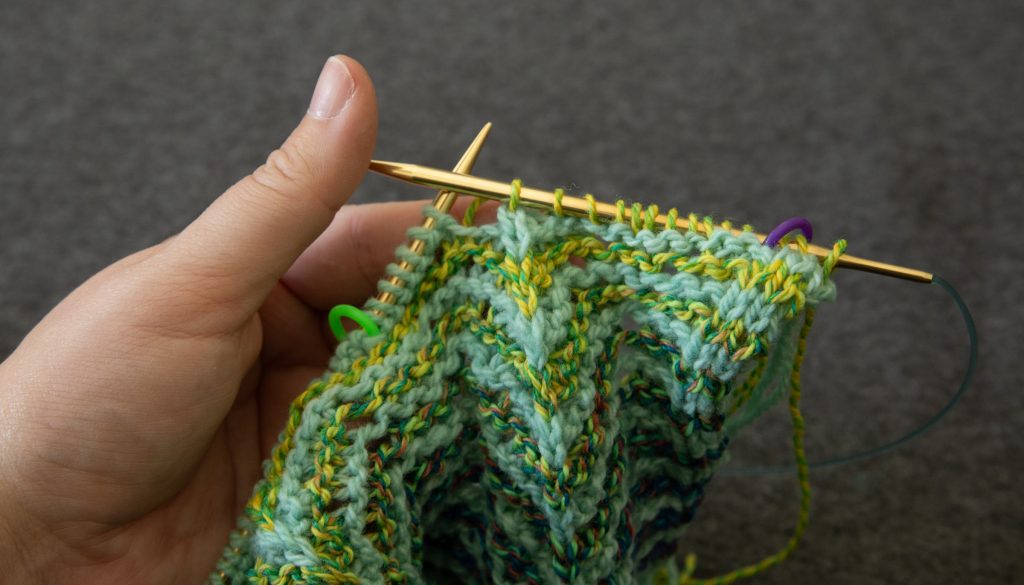
The central quadruple decrease, slip 3 stitches, knit 2 stitches together, pass 3 slipped stitches over, eliminates 4 stitches in a symmetrical way (thus ‘central’ and ‘quadruple’). It creates a strong vertical decrease line that doesn’t slant to the left or the right, the way that the decreases k2tog, ssk, or sl1-k2tog-psso do. We’ve used this decrease in our scrap-tastic Kaleidoscope blanket.
This tutorial includes
- What is a sl3-k2tog-p3sso?
- Sl3-k2tog-p3sso video
- How to work a sl3-k2tog-p3sso decrease
- How does this central decrease line look?
- Other knit decreases
What is a sl3-k2tog-p3sso?
This is a quadruple decrease, that means you are decreasing 4 stitches. To decrease from 5 stitches to just 1 stitch (a net loss of 4 stitches) you’ll to work multiple stitches together and pass slipped stitches over. You’ll slip 3 stitches, knit the next 2 stitches together, then pass the slipped stitches over. You’ll have taken 5 stitches and reduced them down to 1.

In the Kaleidoscope blanket, these central quadruple decreases are worked on the right side rows. This decrease is used to balance out the yarn overs, so the stitch count remains the same. Working this decrease may feel awkward at first, but by the time you are done, you’ll have had enough practice to be very comfortable with it.
Sl3-k2tog-p3sso video
How to work a sl3-k2tog-p3sso decrease
If a single decrease, k2tog (knit 2 stitches together), is new to you check out our k2tog – knit 2 together tutorial.
- Slip the first 3 stitches on the left needle together, as if you were going to work a k3tog (knit 3 together). Insert the right needle through the first 3 stitches on the left needle together, starting with the third, then the second, then the first stitch, then slip them onto the right hand needle without working them.
- Knit the next 2 stitches on the left needle together (k2tog). Now you have 3 slipped stitches and the 1 stitch from the k2tog on the right hand needle.
- To pass the 3 slipped stitches over the k2tog and off, insert your left needle tip through the front of the 3 slipped stitches. Lift the 3 slipped stitches up and over the k2tog and drop them off the needle, leaving a single stitch on the right hand needle.


How does this central decrease line look?
When the sl3-k2tog-p3sso decrease stack up it creates a clear decrease line. In the Kaleidoscope blanket all the other stitches are in garter, but the decrease line and edge stitches are worked in stockinette, making the decrease line even more clear.

Other knit decreases
You can find all of our decrease tutorials here. And look out for our new decrease line tutorial coming soon!
New tutorials, right to your inbox!
We’ll write you a note a couple times a month to share our new knitting tutorials, patterns and stories!


June 29, 2024 @ 7:02 pm
Do you have to pass the 3 slipped stitches over the k2tog at once? I keep dropping the stitch off the needle or splitting the yarn as I pass over. If I pass them over one at a time no problems, but I’m not sure if it will make a difference in the end. So instead of “insert your left needle tip through the front of the 3 slipped stitches. Lift the 3 slipped stitches up and over the k2tog and drop them off the needle, leaving a single stitch on the right hand needle.” I’m inserting my left needle through the first of the 3, lifting it over, then the second is lifted, then after I lift the third I pull the k2tog stitch through the last loop (all of the stitches still go over that stitch).
July 2, 2024 @ 3:51 pm
Hi Rachel – Nope, you can do them one at a time if that’s easier!
June 24, 2024 @ 7:21 pm
I am just starting to use this 4 stitch decrease in brioche, and it’s so much faster and easier than the other way I do it. And it doesn’t require an extra hook to hold the center stitch out of the way. Winning!