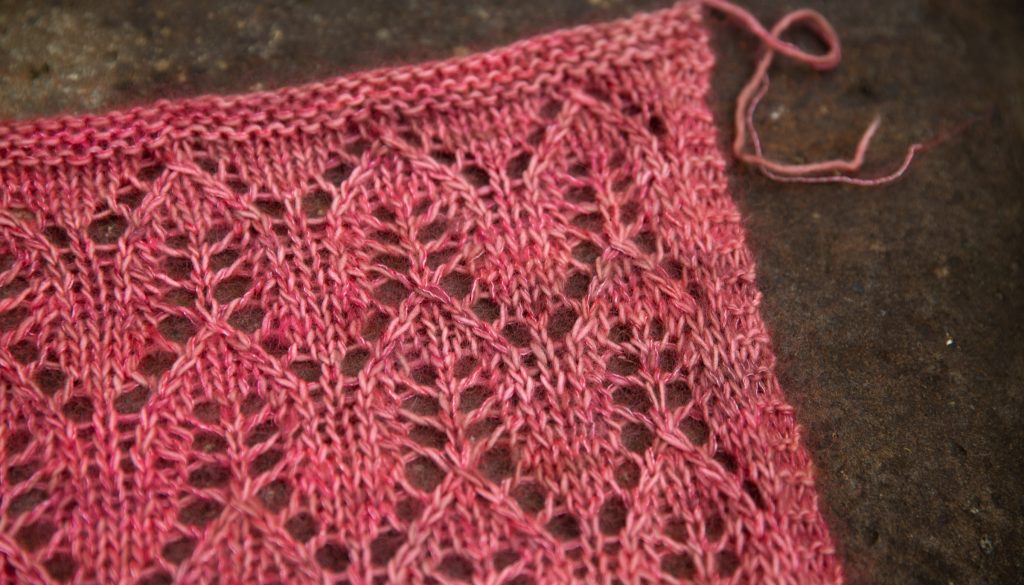
Lace is lovely and fun to knit in SO MANY different types of yarn! This post will give you a little window into the effects you can achieve by using different kinds and weights of yarns when knitting lace! Of course, the best way to learn about this is to grab your own yarn and needles and cast on right now.

Jump to each swatch example following the links below, or just scroll, scroll, scroll!
Getting started with lace?
We LOVE lace, and we think you will too! If you’re ready to learn lace for yourself, we can help – cast on today with our free course, and you’ll learn lace in 1, 2, 3!

It’s ALL specific – make the swatch (it’s fun, trust me!)
Trying to pull out generalizations from my investigation into yarns for lace hasn’t been very fruitful. What I found, instead, is that every yarn had its own personality! Trying each of them in lace was joyful, and gave me ideas about how I’d like to use them in future designs!

Sock weight lace examples
I begin with sock weight, because it’s great for beginners, and for me, still the most fun and versatile weight in which to knit lace. Once you’re a bit more comfortable, you. can move on to lace weight yarns (if you want!).
Single ply sock yarn (superwash)
A single-ply superwash merino is probably one of the most popular ‘base’ yarns that hand-dyers offer, and you can find similar commercially-produced single ply merino yarns like this. Single-ply yarns have great ‘crispness’ of the stitch definition – you can really SEE every little stitch. I also find superwash merino fabric very smooth and drapey (as compared to a non-superwash yarn), creating a fabric which is flowing and fluid after blocking.
Details: US #5 / 3.75mm needle, Qing Fibre Merino Single Bone (400yds / 100g – 100% superwash merino, single ply)


For the Photosynthesis shawl I used Rainbow Heirloom Solo Light (400 yards / 100g – 100% Superwash Wool, single ply) in Snow Melt.
2-ply sock weight yarn (superwash)
Another common base yarn that hand-dyers offer, a 2-ply superwash wool like this is fun to knit in lace. The effect, as you’ll see if you look carefully, is more bumpy and ‘pebbled’ than the single-ply lace. A two-ply yarn like this also has more elasticity, stretch, and ‘bounce’ – so you may find the lace piece shrinks back to a smaller finished size after blocking. You could also say it doesn’t “hold a block” as well as some other yarns. For this reason, you might choose a slightly larger needle size when knitting lace with this kind of yarn. It isn’t as fluid and drapey as the single-ply merino; but since it has more bounce it might be better for a lace garment, like a top or tee.
Details: US #5 / 3.75mm needle, Indigo Moon Island Time Fingering (370 yards / 100g – 100% superwash wool, 2-ply)

4-ply sock weight yarn (superwash)
My next swatch was another common base yarn that hand-dyers offer, a 4-ply superwash wool. The effect here is very crisp lace. Each stitch has lots of definition. It’s smoother than the 2 ply, leaving your lacy stitches to shine. This yarn is somewhere between the single ply and the 2-ply as far as holding a block. It bounces back a bit, but not as much as the 2-ply. It has the right drape for a scarf or shawl, but would also work well in a lace garment.
Details: US #5 / 3.75mm needle, uncertain of the yarn (most hand-dyers offer this sort of a base).


The Estuary shawl is knit up in Old Maiden Aunt Superwash 4-ply.
two-ply sock weight yarn (non-superwash) woollen-spun Shetland
This yarn is a real woolly wool. It’s not as soft as some of the other yarns, but it has a nice rustic feel and the lace pattern shines. This yarn has lots of ‘memory’ so it holds a block really well. Because it’s not a superwash yarn, it’s also extremely light and airy. There isn’t a lot of drape in this yarn, so it’s great for garments, or accessories that you want to hold a bit more shape.
Details: US #5 / 3.75mm needle, Jamieson & Smith Jumper weight (115 yards / 25g – 100% Shetland Wool, 2-ply)

4-ply alpaca blend (non-superwash) smooth-spun yarn
Because of the silk and alpaca that are the primary ingredients in this blend, the resulting fabric is VERY drapey and soft. I love the stitch definition here, and the very slight halo of the alpaca. The stitch definiton is still crisp, even though it’s a drapey fabric.
Details: US #5 / 3.75mm needles. Rainbow Heirloom Lush Light in Aussie Sunshine (437 yards / 100 g – 70% Alpaca, 20% Silk, 10% Cashmere)

Lace weight examples
Once you’ve tried a few sock weight projects, try some delicate lace weight! The motifs are smaller, and more delicate, and the fabric is so very light.
two-ply lace weight yarn (non-superwash) Shetland
This yarn is similar to the jumper weight version above, but even lighter an airier. My swatch feels like nothing at all in my hand! The lace pattern is crisp, and this yarn holds a block really well. This yarn would be great for a garment, or an accessory where a little extra structure is preferred.
Details: 3.75mm needle. Jamieson & Smith 2 Ply Lace Weight, (185 yards / 25g – 100% Shetland Wool, with a touch of lambswool, 2-ply)

two-ply lace weight yarn (non-superwash) cashmere
This yarn was deep in my stash, but I vivedly remember dying it up in this bright green! It’s a lace weight cashmere that is extremely soft, and after blocking has a very slight halo to it. It’s a very light yarn, but with a little bit of structure, so the lace pattern comes through nicely. It has a medium drape, so it would be great for a shawl or accessory, or for a garment.
Details: US #5 / 3.75mm needle, this is a 2-ply lace weight cashmere I hand-dyed


I used a similar yarn to knit this Branching out shawl, Plymouth Earth Ecco Cashmere (354 yards / 50g, 100% cashmere). I loved the way the lace pattern came through, but also the soft drape of the finished shawl.
single-ply lace weight yarn (non-superwash) wool (julie asselin)
I really loved working in this yarn for the Posy shawl. It’s crisp as can be, and check out that iridescent colour too! This yarn feels lovely (it softens with blocking as well), but also has great stitch definition. It was perfect for my shawl, but it would also work well for a garment.
Details: US #6 / 4mm needle. Julie Asselin Nurtured Fine (This yarn comes on a cone. 780 yards / 113g – 100% wool, single ply)

single-ply superwash lace weight
Just like it’s sock weight cousin, the single-ply lace weight is great for lace. It’s soft, smooth, and drapey, with crisp stitch definition as well. Stitch patterns look so delicate in lace weight!
Details: US #5 / 3.75mm needle. Indigdragonfly Merino Single Lace (801 yards / 115g – 100% Superwash wool, single ply)

We used this yarn for the Viewfinder cowl.
mohair-silk lace weight
The fun of fluff! This yarn is a silk strand with fuzzy mohair. It’s light as a feather, lofty, and soft. Mohair has a great halo effect, which does obscure the lace pattern a bit. This yarn holds a block well. The stitches are well defined, but also a bit blurred because of the halo. This would be great for an accessory, or something light and airy to throw on over top. While you can absolutely use this yarn on its own, our favourite thing to do is to hold it together with another yarn. More on that down this post!
Details: US #5 / 3.75mm needle. Rainbow Heirloom Kidsilk Cloud in Favourite Aunty. (420 yards / 50g – 72% Mohair, 18% Silk)

Heavier yarn-weight lace examples
The scale of lace is always fun to play around with. The same pattern can look vastly different when done in a lace weight yarn, vs. an aran weight yarn.
rustic two-ply sock weight (non-superwash) Uist wool
This yarn from Uist has a unique nubbly texture, created by a yarn that runs a little thicker then a little thinner throughout the skein. The rustic nature of this yarn means the stitches are crisp and it holds a block well, but the nubbly texture obscures the lace pattern just a little bit. There isn’t a lot of drape to this yarn. It’s a woolly yarn that holds a block well, perfect for garments especially.
Details: US #6 / 4mm needle. Uist Wool Canach. (180 yards / 50g, 100% merino wool, 2-ply)

handspun two-ply sport weight (non-superwash) self-striping
What a joy it is to experiment with my own handpun yarn. I spun this pretty ombré in a sport weight. It has a slight thick/thin quality to it, and a bit of a marled look as well. Despite the colour changes the lace pattern comes through, and there is solid stitch definition. It has medium drape, so this yarn would work well for an accessory, or a garment.
Details: US #6 / 4mm needle. It has a bit of a thick/thin quality, but it’s a sport weight yarn overall.

2-ply superwash DK
For the Prairie Fire sweater I wanted crisp stitch definition on the leaf lace, so I went with a 2-ply superwash yarn. Just like the sock weight version this yarn bounces back a little after blocking. This yarn is more structured than drapey.
Details: US #6 / 4mm needles. SweetGeorgia Yarns Superwash DK. (256 yards / 115g – 100% superwash wool, 2-ply)

marled: single-ply sock with lace-weight mohair yarn
One of our current favourite knitting activities is pairing a sock and a mohair yarn. We wrote ALL about colour combinations with this type of pairing here. When combined, the sock adds a bit of structure and bulk, while the mohair sits happily alongside, bringing a lovely halo to the work. This combination is great on a slightly larger needle than usual, giving it lots of drape. We used this combination for the Love Note sweater and the Posy shawl.
Details: US #8 / 5.0mm needle (but a US #9 / 5.5mm or even a US #10 / 6mm would be lovely too!). Rainbow Heirloom Kidsilk Cloud in Favourite Aunty with Qing Fibre Merino Single Bone.


rustic 2-ply aran weight (Canadian)
For the Oaken shawl I wanted something on a larger scale. Sweet Fiber Canadian is an aran weight yarn, so the lace motif is much bigger than it would be in a more delicate yarn. It’s got lots of stitch definitely, and a slight heather to it. It held a block well, and the shawl is more structured than drapey. Since it’s a non-superwash wool, it’s got lots of bounce to it and I would describe it as a squishy yarn.
Details: US #9 / 5.5mm needles. Sweet Fiber Canadian in Golden. (208 yards / 100g – 100% wool, 2-ply)

rustic 2-ply aran weight alpaca blend
For the Oaken blanket I went with the same weight of yarn, an aran weight, but an alpaca blend. Adding in the alpaca made the yarn softer, warmer, and gave it more drape. This particular yarn also had a light halo after blocking. There is slightly less stitch definition compared to the Canadian yarn, but it’s still quite well defined.
Details: US #9 / 5.5mm. Hinterland Range in Snow and Maple (198 yrds / 112g, 50% Rambouillet wool and 50% Alpaca)

So what does it all mean?
The short answer is: it depends. Which yarn is right for your lace project really depends on what you like, and the type of project you’re working on. Are you looking for a super soft, light, and drapey accessory? Then a lace weight in a cashmere, or an alpaca blend might be just the thing. For a chunky lace sweater you could go with a rustic aran weight yarn, or for a more drapey look with a halo you could try a sock yarn held together with a mohair.
Whichever yarn speaks to you, it’s best to do a swatch first. See how your motif plays with your yarn and check to see that you like the density you’re getting on the suggested needle. I had a lot of fun swatching all of these different yarns, and I’m sure you will too!
❤️ Emily


May 9, 2026 @ 11:16 am
I taught myself to knit lace using what I call “kitchen cotton” or Peaches and Cream yarn and making lace washcloths. No pressure because if I made a mistake, it was going into the sink and wouldn’t matter! There were plenty of free lace washcloth patterns on the internet. Today, I love to knit lace. The key is to be generous with using stitch markers.
April 29, 2026 @ 3:00 pm
And then there’s cobweb weight, which is terrifying to use but spectacular for a wedding shawl!
Your examples are so gorgeous and informative, thank you.
April 29, 2026 @ 9:03 am
Fascinating and informative! The example photos are wonderful! I can knit kace (a little…) and will certainly be experimenting with yarns.
Thanks so much!
April 29, 2026 @ 7:50 am
Wow! 😮 What a thorough presentation of all the different aspects of knitting with various yarns and weights. You’re fabulous!!