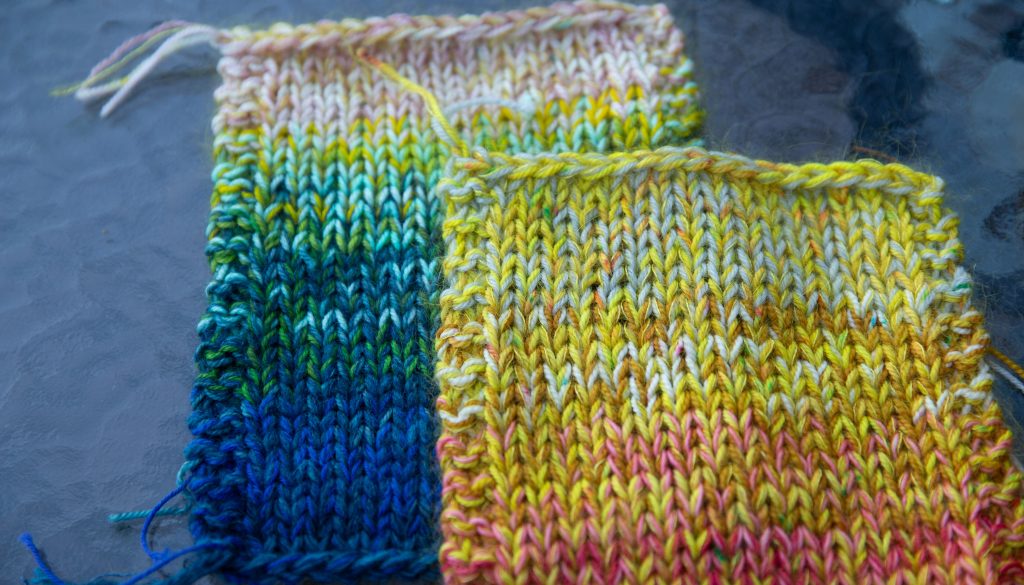
Sometimes, in knitting, one strand just isn’t enough.
You might want to hold two (or more) strands together to create a heavier yarn. This could be two strands of the same yarn, different yarns, different colours, or maybe you’re adding a bit of texture to your knit. This technique of using multiple strands is also called ‘marling’.

But how do you actually KNIT holding multiple yarns together?
Here we’ve got a video tutorial and photo tutorial showing how easy it is to knit holding multiple yarns together, as well as a few examples of what happens when try different combinations.
When you’re working with multiple strands, the key is to treat them as if they were all one strand. So when you insert your needle, ready to work your next stitch, you’re going through all of the strands, and you’re wrapping all of the strands around the needle.

In the image above I’m holding together a strand of pink sock yarn and a strand of variegated fluffy lace weight yarn. I’ve inserted my needle through both strands, which is one stitch, and I’m ready to wrap both strands around my needle.

Here I’m working on a swatch for the Snap sweater. I’ve got 3 strands of sock yarn and one strand of a fluffy lace weight yarn. I’ve got my needle inserted through all 4 strands, which is one stitch, and I’m ready to wrap all 4 strands around the needle. For this swatch I’m swapping in a new sock yarn every inch or so to create an ombré effect.
Marling and gauge
When adding yarns together you’ll get a thicker yarn…but how much thicker?! It sometimes comes down to trial and error, but here are a few guidelines to get you started:

For the Snap hat we used 4 strands of sock weight yarn, to achieve about a chunky weight. We used US #10.5 / 6.5mm needles to create the right density of fabric for our hat. Instead of using 4 strands of sock yarn, you could try:
- 1 DK / worsted weight + 2 sock weight
- 1 DK / worsted weight + 1 sock weight + 2 lace weight
- 2 sock weight + 3-4 lace weight

If you’re holding together a sock weight yarn and a fluffy lace weight, like we do in the Love Note sweater, you might want to play around with the gauge. For Love Note we chose a more open fabric, using a US #10 / 6mm needle. But a sock plus fluff also works great as a DK or worsted weight yarn, on needles ranging from a US #6 / 4mm to US #8 / 5mm.

For the Snap sweater we held together 3 strands of sock weight yarn with 1 strand of lace weight fluff. Using US #11 / 8mm needles for a fabric with lots of drape. Instead of 3 strands of sock yarn and one lace, you could try:
- 1 DK + 1 sock weight + 1 lace weight
- 1 DK + 2-3 lace weight
- 2 sock weight + 2-3 lace weight
Even though yarn is usually categorized into weights like lace, sock, sport, DK, worsted, etc. there is variation within those categories. You can have a plumper or thinner worsted weight yarn, for example. So this is a good moment to swatch. See how you like the fabric, and whether it’s suitable for your intended knit.
To wind together or not?
It might be tempting to wind both of your yarns together, and if you do this it might be just fine, but I prefer to work from separate balls, and here’s why:
When working with multiple strands I find that one yarn uses very slightly less than the other. It has to do with how the yarns are interacting in each stitch. One strand might sit on top of or below the other, meaning it uses very slightly more or less yarn.
This is a small thing, but over many, many, many stitches it can mean you’ve got one yarn that’s used an inch or two more yarn than the other, so you have to separate the strands in the combined ball, constantly smoothing them out as you go.
It’s only a small annoyance, but if you work from separate balls you won’t have this problem.
A few marled examples
Marling can look lots of different ways (that’s really the beauty of it!), here are a few examples.
Holding 2 strands of the same yarn together
One of the best uses for holding yarns together is simply to achieve a thicker yarn by doubling (or tripling) thinner yarns that you have on hand. We’ve described this in this blog post on holding yarns together. If you’ve collected sock yarns, but find you don’t like knitting at fine gauge, this is a great way to use up thinner yarns.
For Hunter’s Beloved bonnet below I held 2 strands of sock yarn together, for about a DK weight yarn.

Holding 2 strands of the same yarn (but different colours) together
Here we’ve got a Simple Sweater, and Emily’s held together 2 strands of Brooklyn Tweed Loft. One colour is a mustard yellow, and one is a warm grey. Mixed together it’s got a lovely tweedy effect. These 2 strands of sock yarn together gave her a worsted weight yarn.


Holding many strands together
For the Snap hat and sweater we’ve used multiple strands, and swapped in a new strand every couple of inches to give it that ombré effect as well. For the hat we held together 4 strands of sock yarn, and for the sweater we held together 3 strands of sock yarn and a lace weight fluff.


Holding a mohair and a sock together
For our popular Love Note sweater we held together a sock weight yarn and a lace weight mohair. It was such a fun project to swatch for! Check out our post on Layering With Mohair to see all of our swatches and experiments with this combination.

Get your Marl on!
Want to learn more about marling? Check out our marling tutorial here. It’s full of examples of different kinds of marls.
We love a marl here at TCK, holding multiple strands is always a good time. Here are our favourite patterns to get started!


Hush sweater, The World’s Simplest Mittens, Marley Blanket, Snap hat, Snap sweater, Love Note sweater


October 29, 2026 @ 4:00 am
I’m going exactly this on a Barley hat!